Northern Ireland Advocate Calls for Overhaul of Adult Social Care Legislation
During the last two years I have had the fascinating opportunity to work on two major studies of laws and government policies affecting older persons and their families in Northern Ireland, studies initiated by the Commissioner for Older People for Northern Ireland (COPNI). The earlier study looked at safeguarding systems. Now the second study has been made public, with Northern Ireland Commissioner Claire Keatinge using the work to recommend major reforms of Adult Social Care laws in her country. 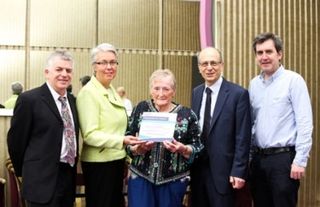
Two of my four research colleagues, Dr. Joe Duffy (far left, who led the research team) and Dr. Gavin Davidson, (far right) both of Queens University Belfast, were present for the launch, with Joe giving introductory remarks to the audience of government officials and community stakeholders. The fourth member of our team is Dr. Subhajit Basu of the University of Leeds in England. Our research evaluated government policies and law in more than ten nations, looking for legal trends, best practices and cutting edge social care programs.
Significantly, in addition to recommending a comprehensive legislative framework and funding structure to coordinate services for all adults in need of assistance, one key recommendation announced by Commissioner Keatinge (left center above) and highlighted in our investigative report, is to implement a “Support Visit” for any interested person age 75 years or older, by an appropriately trained health and social care worker. This recommendation, which draws upon Denmark’s successful experience with a “preventative home visitor” program, would create an opportunity for a psychosocial dialogue aimed at advance planning. The goal is to help individuals and family members anticipate needs in the event of functional impairment, thus reducing the need for crisis planning.
I’ve become a big fan of Commissioner Keatinge; she is clear, creative, realistic, and determined to see Northern Ireland become a world leader in recognizing not just the needs but the contributions made by older adults. She does so from a platform of respecting older persons’ contributions, citing research to demonstrate that over the next several decades, older adults will contribute more than £25 billion to the Northern Ireland economy through formal work, volunteering, and their roles as caretakers for both adults and children.
It had been an honor for me to work on this social care reform project. The work has given me — and Dickinson Law students serving as research assistants, Ryan Givens and Tucker Anderson (who used his ability to speak and translate Danish to help in our field research) — important new perspectives on proactive ways to identify and address potential needs triggered by age-related changes in demographics. Frankly, in the U.S. we spend far more time (and arguably too much time) on issues of medical care. This report is a reminder that many health-care crises could be avoided or mitigated through more proactive implementation of social care networks.
For more on the Duffy, Davidson, Basu, Pearson report (June 2015), see Review of Legislation & Policy Guidance Relating to Adult Social Care in Northern Ireland.For more on Commissioner Claire Keatinge’s call for reform, see Commissioner Calls for Overhaul of Adult Social Care.
See here, for more on Denmark’s approaches to services, communication and programming for older people.
Special thanks to Ryan and Tucker for their research, proofreading, editing and translation skills!