Supported Decision-Making as an Alternative to Adult Guardianship
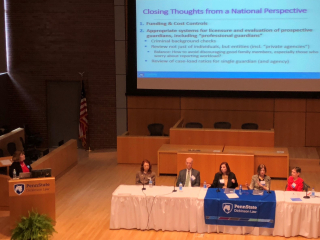
For background, as we discussed with the judges, under most states’ laws governing guardianships, courts are obligated to search for the least restrictive alternative to a plenary guardianship. Courts sometimes struggle with this issue, especially for older adults, if the incapacitating issue proves to be any of the forms of progressive neurocognitive disorders associated with dementia. If a judge makes a finding of incapacity, and if there is an appropriate, trustworthy guardian available, the judge may feel that it is better to leave it up to the appointed individual to strike the right balance between protection and autonomy on individual issues such as choice of housing or daily activities. The court might find that granting full powers, but trusting the guardian to exercise the powers appropriately, is better than requiring the parties to return to the court for a series of orders, as the incapacity advances, conferring new directions for the guardian to follow.
During the conference we confronted the issues driving the recent calls for reform of guardianship systems, including the latest well-publicized incidents of abuse of authority by an appointed guardian or a private guardianship agency, in locations such as Las Vegas, Nevada and New Mexico.
A published commentary by Cardozo Law’s Rebekah Diller, an associate clinical professor, explains the movement behind supported-decision making as a better alternative:
During the last several decades, guardianship has been the subject of continual calls for reform, often spurred by revelations of guardian malfeasance and other abuses in the system. Recent developments in international human rights law and disability rights advocacy, however, pose a more fundamental challenge to the institution. Article 12 of the United Nations Convention on the Rights of Persons with Disabilities (CRPD), with its declaration that everyone, regardless of mental disability or cognitive impairment, is entitled to make decisions and have those decisions recognized under the law, offers no less than a promise to end adult guardianship as we know it.
So, what exactly is “supported decision-making?” Professor Diller explains:
The support can take the form of accessible formats or technological assistance in communication. Or it can take the form of “supported decision-making” arrangement, in which “supporters” assist individuals with decision-making in relationships of trust. In whatever form, the support is an appropriate accommodation that enables the individual to enjoy the right to legal capacity.
The author warns there is no single model for supported decision-making. Ideally, the individual designates in advance his or her desired supporter, and the movement behind this approach believes this selection can be recognized even if the individual might not be found to have the requisite capacity to enter into a contract or to execute a formal power of attorney.
In 2015, Texas became the first state in the U.S. to pass a supported decision-making statute, and the Texas statutory approach views this option as a better alternative for individuals who need assistance in making decisions about activities of daily living, but who are not considered to be “incapacitated” as that concept is defined in guardianship law. The Texas statute contemplates an individual who can act voluntarily, in the absence of coercion or undue influence. Information about Texas’ law is available here.
In 2016, Delaware became the second state to enact legislation enabling the option of Supported Decision-Making, with Senate Bill 230.
In 2012, the ABA Commission on Disability Rights and the ABA Commission on Law and Aging, working with U.S. government representatives, hosted a round table discussion on supported decision making for individuals with “intellectual disabilities.” The ABA captured a host of materials related to this discussion on this website.
In 2017, the ABA House of Delegates adopted a resolution on supported decision-making and endorsed its possible use as a less-restrictive alternative to guardianship, including use of this approach as grounds for termination of an existing guardianship and restoration of rights.
Earlier this year, on February 15, 2018, the ABA hosted a webinar on “Supported Decision-Making as a Less Restrictive Alternative: What Judges Need to Know.” While the webinar appears to have been offered only as a one-time “live” option, perhaps a recording will become available in the near future. Here’s an ABA webpage providing details.
My special thanks to Pennsylvania Elder Law Attorney Sally Schoffstall, who served as a panelist at the Dickinson Law event last week, for providing me with a copy of The Arc’s information on the Texas Supported Decision-Making law, linked above. Additional thanks to Dickinson Law James Adams for photographing the conference!