Urging Canada to Move Boldly, While Also Adopting Safeguards, in Development of Treatments for Alzheimer’s Disease
As many readers will know, during the last several months I’ve worked under the auspices of the Fulbright Scholar program, serving as the 2024-25 Visiting Research Fellow at University of Ottawa’s Centre for Health Law, Policy and Ethics. In that role, I had an opportunity to consider carefully issues at the intersection of aging, health practices, legal regulations, government policy and ethics. High on this list of overlapping concerns is the need for solutions to Alzheimer’s Disease.
The development of treatments for Alzheimer’s Disease requires bold thinking and, as I have learned, lots of data capture in order to craft safeguards and monitor results accurately. Dr. Andrew Frank, a cognitive neurologist at Bruyere Health Research Institute in Ottawa, shared hours of his time with me, walking me through how he approaches consideration of potential therapies in his cognitive neurological clinic.
This spring, I also taught an elder law module at Penn State Dickinson Law where my law students explored patient’s wishes, as well as risks, benefits and safeguards for Alzheimer’s medications, with awareness of serious mishandling of some key data in the past. With careful consideration of risks and after weighing the importance of treatment for the disease, I recently joined Dr. Frank in writing to urge Canada as a nation to move forward on development of medications. On Thursday, our joint Op-Ed essay appeared in the Montreal Gazette.
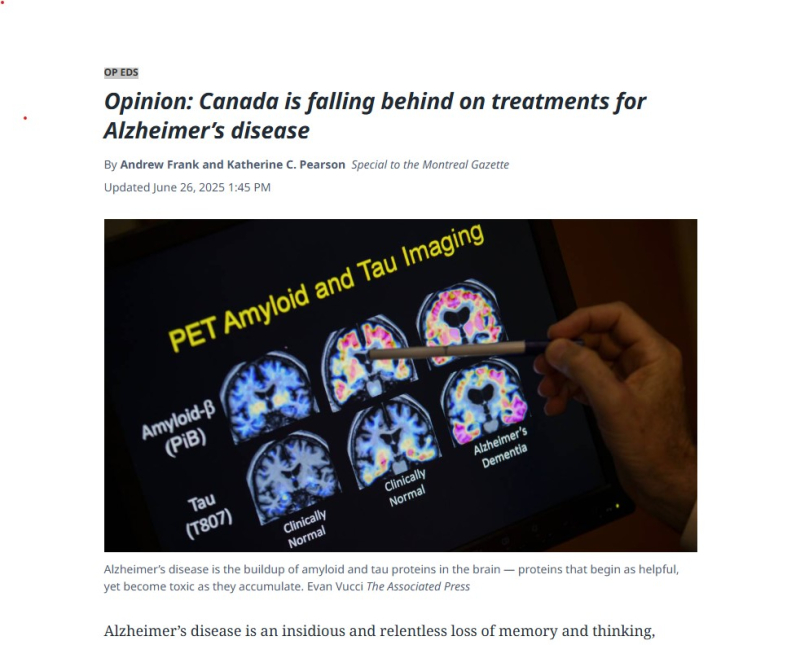
You may be able to read the full article (there is a paywall triggered by multiple access attempts) on the Montreal Gazette here. We welcome your comments online. My special thanks go to Professor of Law Vanessa Gruben at University of Ottawa and Dr. Kumanan Wilson at Bruyere, who offered important encouragement for our collaborative work.