uOttawa Report: Dynamic Programming on “Governing Reproduction” at Centre for Health Law, Policy and Ethics

I was very interested to hear an especially persuasive presentation on the topic of abortion law by Joanna Erdman, Professor of Health Law and Policy at Dalhousie University. Professor Erdman approached the topic of regulation from the perspective of health care as a public right, and the need for public spaces to access such care. She connects the need for a functioning means of abortion care in a public space to the need for security, privacy and dignity. Intriguing. It made me think about an issue I’ve been watching from Ottawa play out on the evening news in nearby Buffalo, New York, where the community is facing the closure of a long-standing and respected local nursing home, triggering public outcry as this will affect 100+residents and more than 300 jobs. The closure is triggered by inadequate public and private funds to keep operating. Public nursing homes are at risk of “failing” all over the United States.
On the second day of the conference, the panel on surrogacy captured my attention. 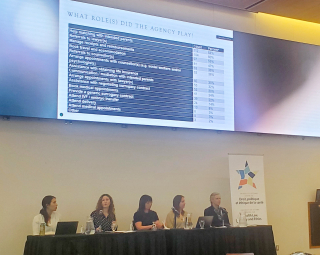
In Canada, federal law makes it illegal to “pay” surrogates or to pay certain intermediaries, sometimes called surrogacy agencies or brokers, for “matching” potential parents with potential surrogates. But despite that federal law, more than a dozen surrogacy agencies are operating in Canada, sometimes appearing to avoid federal attention by taking the position they are not charging for “matching” but rather for “other” services needed by the parties to the contract during the gestational period.
The speakers on potential regulatory issues for surrogacy arrangements included Vanessa Gruben, Professor of Law at uOttawa and also the Director of the Centre for Health Law, Policy and Ethics, Stephanie Carsley, Professor of Law, uOttawa, and Alicia Czarnwoski, a PhD candidate at uOttawa who spoke about her survey of the operators of commercial ventures involved in facilitation of surrogacy. Isabel Côté, Canada Research Chair in Third-Party Reproduction and Family Ties from the University of Quebec, also spoke about her research into reactions of family members to the roles of surrogates.
Of course, all of that got me thinking, especially when I heard that some 40% of surrogacy contracts in Canada may involve intended parents from outside of Canada. I’m teaching Conflict of Laws when I return to Penn State Dickinson Law in January. Heads up to my students! You can expect a cross-border and federalism fact pattern between U.S and Canada in the realm of surrogacy! What jurisdiction’s law controls if a contract issue arises? If tort issues arise? If “fraud” exists?