Do POLST Forms Require Authorizing Legislation to be Effective?
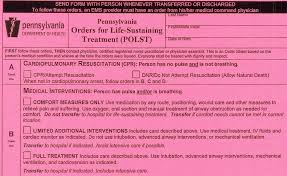
But is this same reasoning applicable to POLST forms? Is legislation required to make this form of “planning” effective? As currently used, the forms require a conversation between the health care provider and the patient (or the patient’s representative — and that can get tricky in Pennsylvania), usually in the context of hospitalization or an immediate or looming health crisis, that results in the patient’s “informed” decisions becoming the “doctor’s order” for treatment. In 2006, a Pennsylvania law directed establishment of an advisory committee “to assist in determining the advisability of using” POLST forms that “detail the scope of medical treatment for patients’ life-sustaining wishes.” The committee included representatives of the state’s medical society, the joint state government commission that advises on Pennsylvania law, the Pennsylvania Bar association and relevant state agencies. Following a grass roots movement to implement the POLST concept, eventually a Pennsylvania Department of Health form was developed and approved on a trial basis with individual hospitals. The bright pink POLST forms currently in use in Pennsylvania certainly look “official.”
In December 2018, after another attempt to create clear state authority for POLST failed to reach a vote in the Pennsylvania House, one of the Senate sponsors wrote to explain why passage is important. Senator Gene Yaw takes the position that clarity of scope of authority, prohibitions on improper insurance company use, portability or the orders for transfers between facilities and clarity of application during emergency medical services are all necessary elements of statutory authority, needed to assure that “individuals … have the right to dictate end-of-life decisions in a manner that is sensitive to the situation at hand.” Two bills are currently pending, PA Senate Bill 142 (Printer’s No. 117) and PA House Bill 997 (Printer’s No. 1118).
In the meantime, it seems that patients are creating POLST orders with physicians in Pennsylvania, without authorizing legislation.